In Vietnam, singing does not necessarily require going to a KTV.
At family meals, gatherings with friends, and even holiday reunions, a speaker system and two microphones can make an ordinary living room lively.
Interestingly, as more and more entertainment activities can be completed at home, consumers' requirements for speakers have also begun to become more complex.
Not only must people be able to sing to their heart's content, but they must also consider space, budget, and whether they will disturb their neighbors.
KARAOKE & SOCIAL CULTURE
Singing has a broad social foundation in Vietnam.
According to information published by the Ministry of Culture, Sports and Tourism of Vietnam, as of 2025 March, there were 12,874 karaoke businesses nationwide.
In home settings, Bluetooth speakers, wireless microphones, and song selection via mobile phone mean that singing no longer depends on professional entertainment venues.
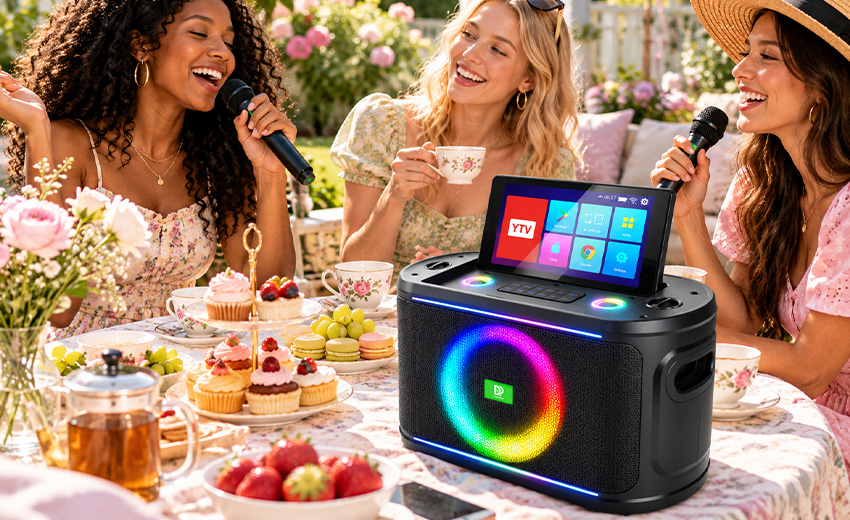
In the past, if you wanted to sing, you might need to invite friends to a KTV; now, by connecting a mobile phone and turning on the music, you can sing a song at home.
However, the number of business venues does not represent the penetration rate of home Karaoke equipment.
What is truly worth noting is that music entertainment is breaking through the limitations of fixed venues and integrating into more everyday life scenarios.
MUSIC CHARTS · NOVEMBER 2026
According to the Vietnam Spotify weekly chart on 2026 November 5, the five most-streamed songs are as follows:
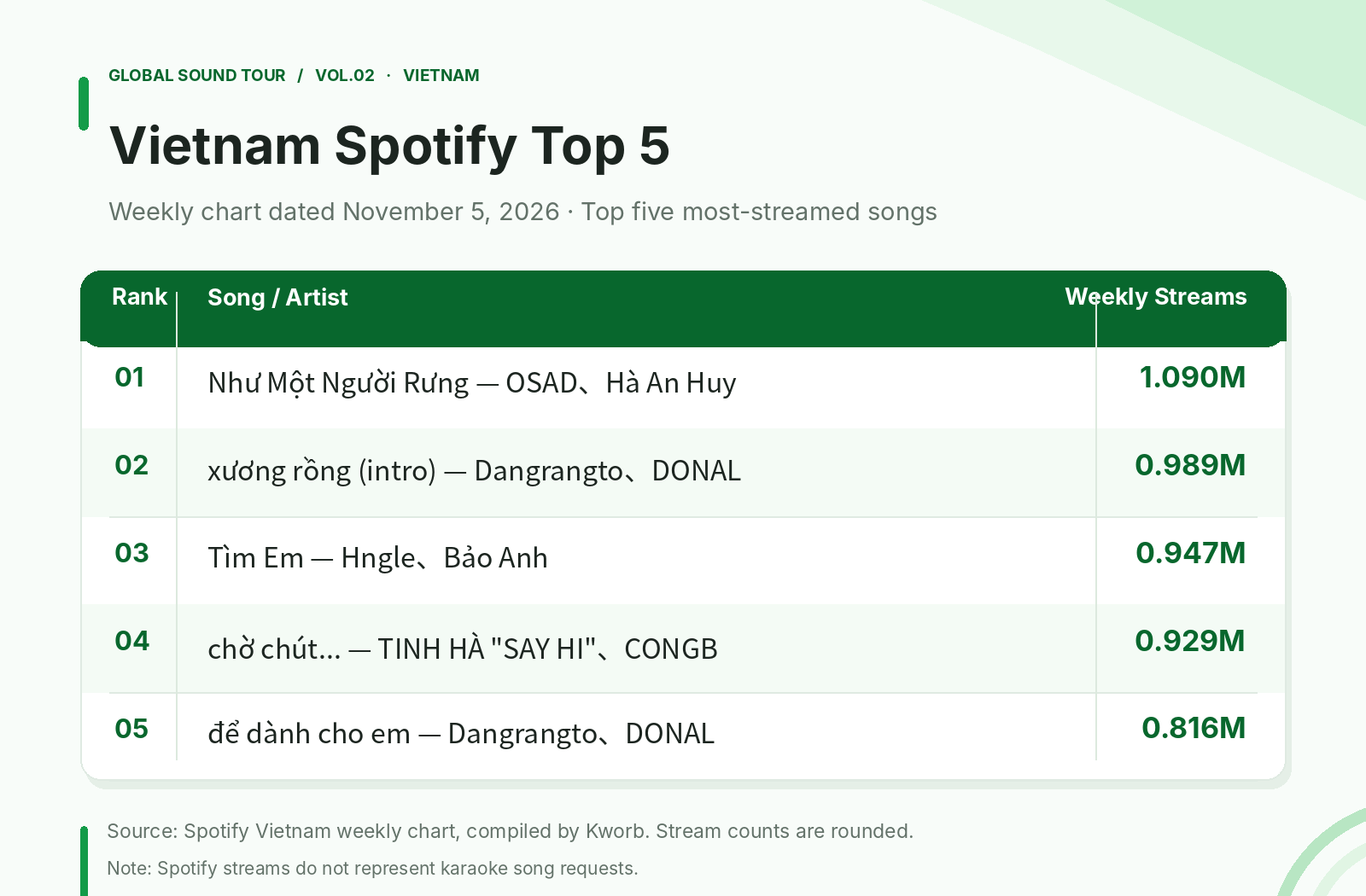
One obvious feature is that the top five songs on the chart are all Vietnamese-language songs.
From pop melodies to rap elements, local music is developing a distinctive mode of expression while also demonstrating young listeners' acceptance of different musical styles.
Of course, the songs people listen to most are not necessarily the songs they sing most in KTV venues.
But the chart at least shows that local music content has considerable dissemination capacity and provides a sustained content foundation for the local music entertainment ecosystem.
CONSUMER SPENDING & SPEAKER MARKET
Data from the General Statistics Office of Vietnam show that in 2025, Vietnam's GDP per capita was approximately 5,026 US dollars, and the average monthly income per capita was approximately 5.9 million Vietnamese dong, up 9.3% from the previous year; the full-year consumer price index rose 3.31%.
Income growth has created conditions for entertainment consumption, but GDP per capita does not equal an individual's actual disposable budget.
Let us also look at local speaker retail prices.
In FPT Shop's public retail channels in Vietnam, the following price samples can be observed:
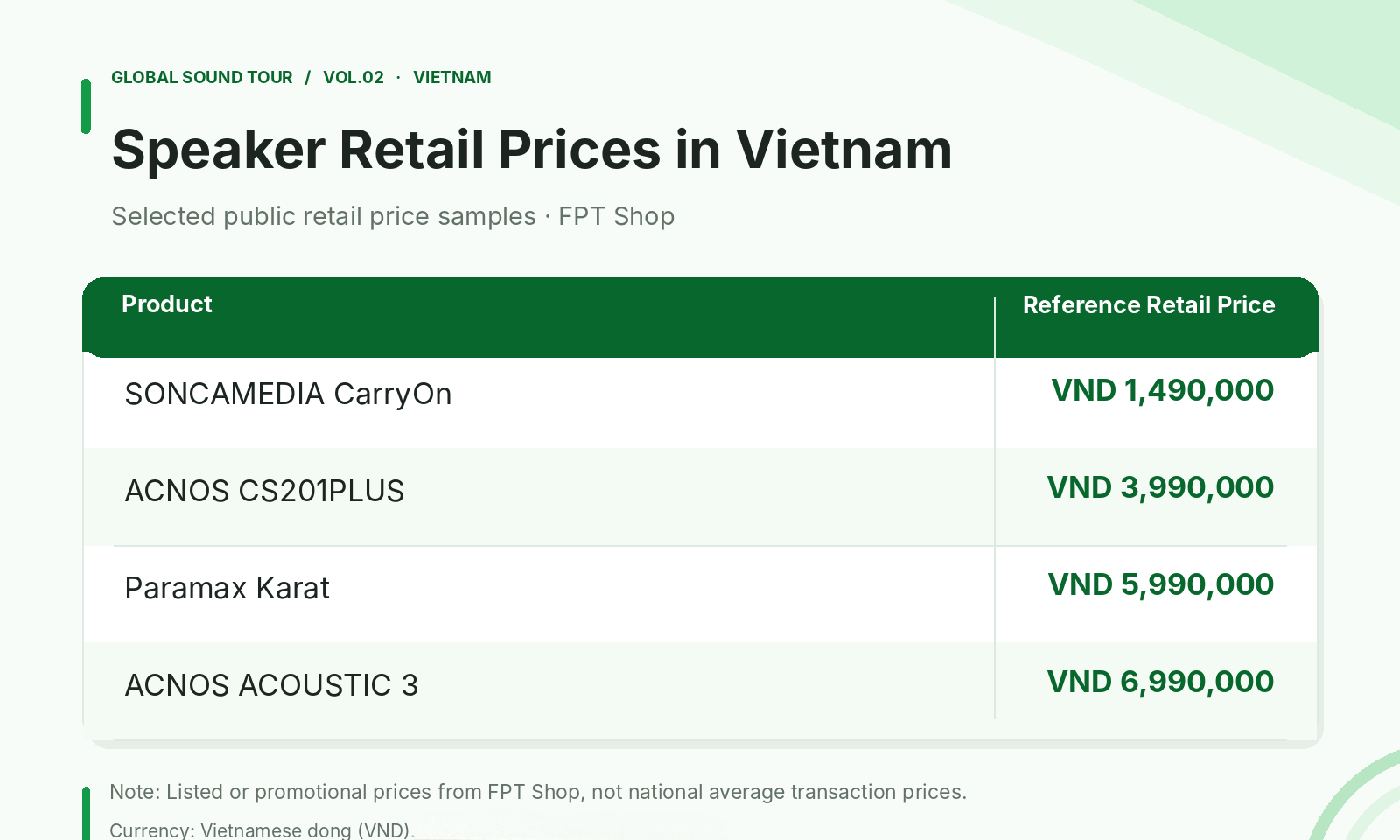
Prices range from more than one million to several million Vietnamese dong, reflecting differences between products with different positioning.
Some emphasize lightness and portability, while others highlight vocal performance, wireless microphones, or more ample power.
This also shows that the speaker market cannot be simply divided into high and low tiers by power.What truly influences purchasing decisions is whether price, functions, and user experience match.
A CHANGING KARAOKE CULTURE
Vietnam's Karaoke culture is facing a real issue: noise.
On December 15, 2025, Vietnam's Decree No. 282/2025/NĐ-CP officially came into effect. Together with relevant environmental noise regulations, noise disturbances in residential areas are no longer an issue that requires attention only late at night.
This does not prohibit singing Karaoke at home; rather, it emphasizes that entertainment activities must not affect other people's normal lives.
When Thanh Nien newspaper of Vietnam visited the audio market in Ho Chi Minh City at the end of 2025, it found that some merchants reported a slowdown in demand for high-power speakers, while small indoor audio systems were receiving more attention.
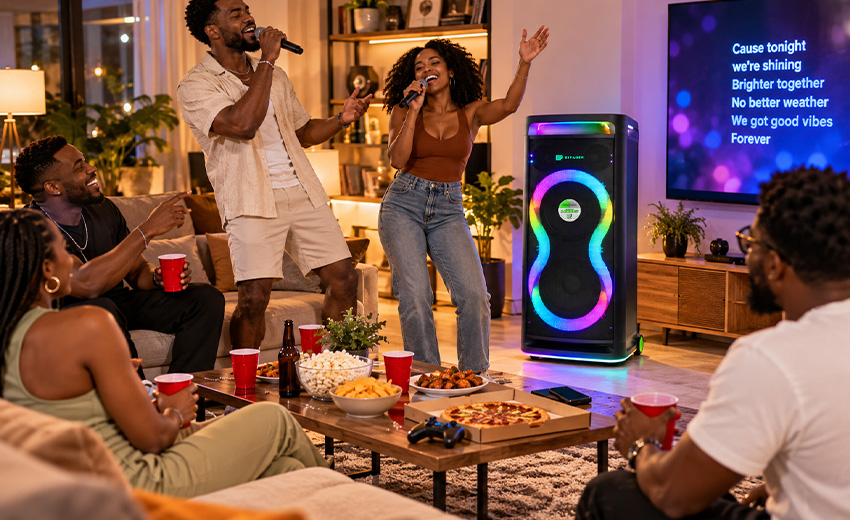
Although this is only a local market observation and cannot represent sales trends across Vietnam, it raises a question worth considering:
Does a good home Karaoke speaker necessarily have to become louder and louder?
The answer is obviously not that simple.
In ordinary homes, clear vocals, convenient operation, and appropriate volume are often more practical than the single-minded pursuit of high power.
In spacious venues, outdoor activities, and larger gatherings, ample sound output capability still has its value.
The key is not which product is better, but where it is used.
PRODUCT MATCHING · DIPAOER
From home Karaoke to gatherings with friends, different forms of entertainment also have different requirements for speakers.
Integrated audio and video for simpler home entertainment.
DP-1435 integrates video display, music playback, and Karaoke functions. It is equipped with a foldable display, RGB lighting effects, and dual wireless microphones; 60W power output combined with a compact body makes home singing more convenient.
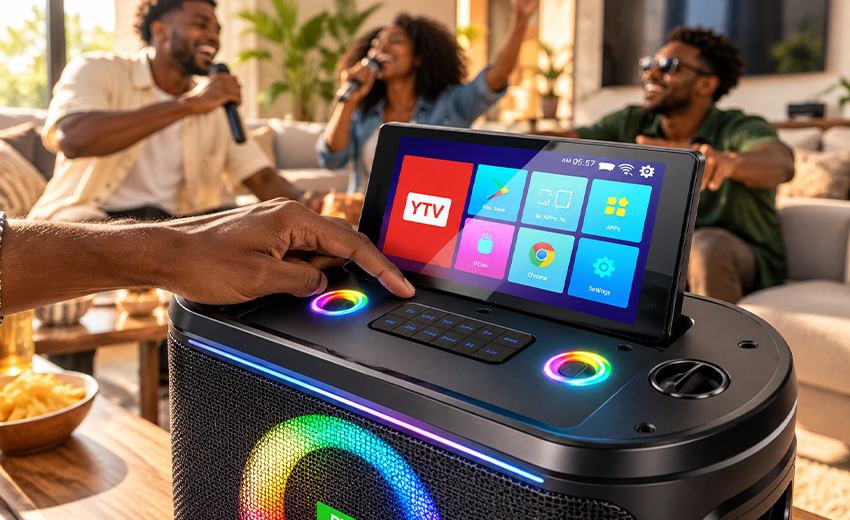
There is no need to go to a KTV specifically; at home, you can enjoy listening to music, watching videos, and singing.
Wooden cabinet and powerful sound for more enjoyable gatherings.
DP-1013 features a wooden cabinet design and is equipped with dual 10-inch woofer units; with 200W power output, it provides ample sound support for music playback and Karaoke.
RGB colorful lighting effects, dual wireless microphones, and a built-in battery make party entertainment richer; the roller design at the bottom also makes movement more convenient.
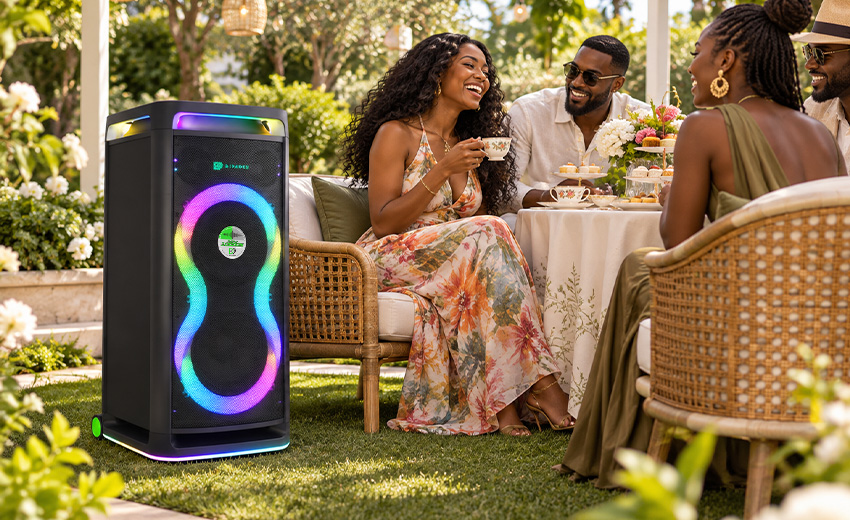
Whether for family singing or gatherings with friends, it can easily create a lively musical atmosphere.
Vietnam's Karaoke culture shows us that music has long been integrated into family and social life. But a good entertainment experience is not just about pursuing greater volume; it is more about finding a way that suits you.
From home audio-visual entertainment to party celebrations, we hope that through different product designs, every way of loving music can be expressed appropriately.
DIPAOER · Set Great Sound Free.

Copyright © Guangzhou Xinyang Electronic Technology Development Co., Ltd. All Rights Reserved. 粤ICP备2025507395号 Sitemap XML DIPAOER